

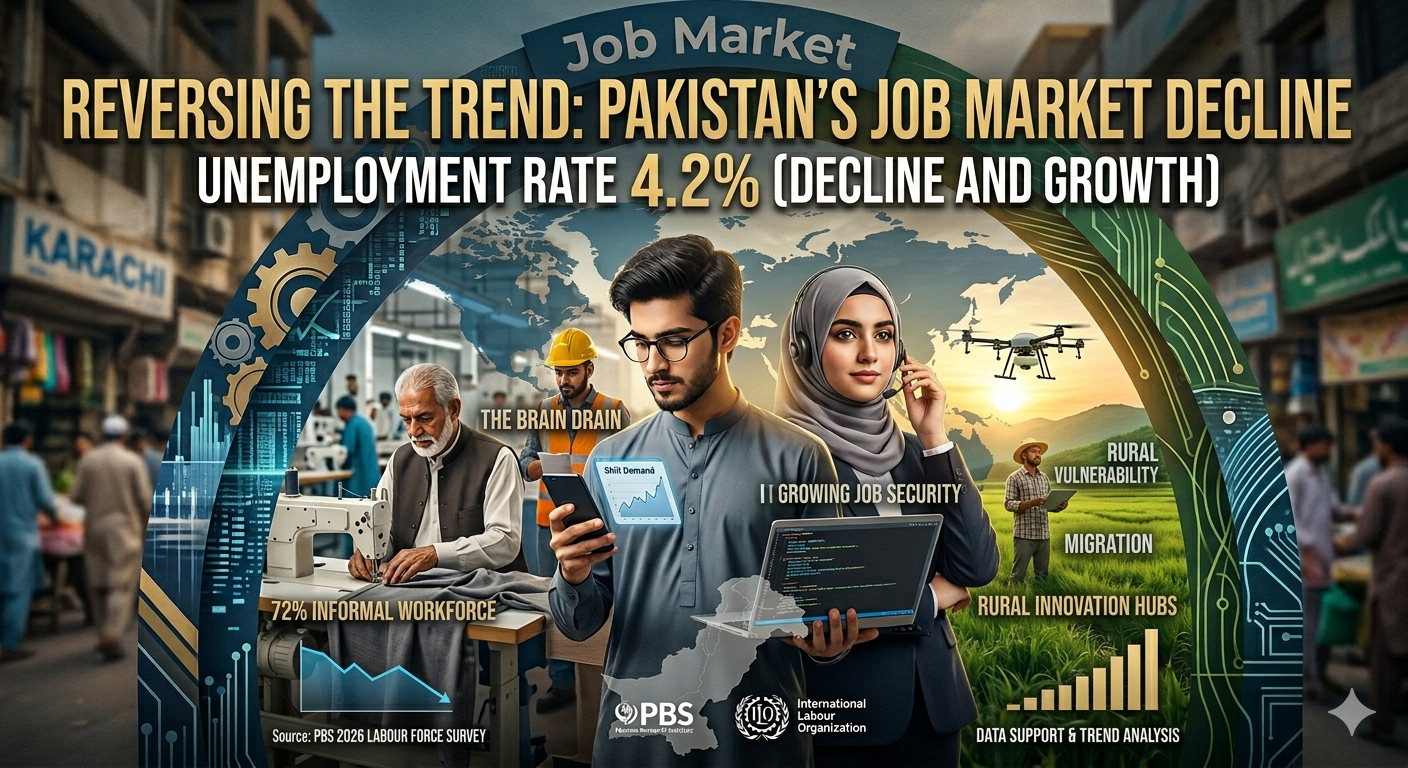

The job market in Pakistan is currently at a critical crossroads. As of 2026, the country is balancing a burgeoning youth population with an economic landscape that is rapidly shifting toward digitalization and services.
1. The Numbers: A Statistical Snapshot (2026)
While the headline numbers suggest a stable surface, the granular data reveals significant pressure on the workforce.
| Indicator | Estimated Figure (2026) | Trend Comparison |
| Total Unemployment Rate | ~6.9% | Moderate increase from 6.3% in 2024 |
| Youth Unemployment (15-24) | 11% – 22% | High variance; highest among urban graduates |
| Informal Employment | 72.5% | Persistent; the primary absorber of labor |
| Inflation (Headline) | 6.4% | Down from historic peaks, but living costs remain high |
| GDP Growth | 3.5% | Recovering, but below the 7% needed to absorb new labor |
The “Youth Bulge” Challenge
Over 64% of Pakistan’s population is under the age of 30. Every year, roughly 2 million new workers enter the labor market. The current economic growth rate is not yet sufficient to create enough formal jobs to absorb this massive influx, leading to intense competition and “educational inflation” (where graduates take jobs far below their skill levels).
2. Sectoral Analysis: Where the Jobs Are (and Aren’t)
A. Agriculture (The Stagnating Backbone)
Historically the largest employer, agriculture is struggling with climate-related disruptions (floods and heatwaves). Low mechanization and water scarcity have reduced productivity, leading to rural-to-urban migration as workers seek more stable income in cities.
B. The “Freelance Revolution” (The Digital Frontier)
Pakistan remains a global leader in the gig economy.
- IT Services: Export of software services and remote development has become a vital source of “hidden” employment.
- Gig Economy: Platforms like Fiverr, Upwork, and local delivery/ride-hailing apps provide a safety net for those unable to find formal office work.
C. Services & Retail (The Current Growth Engine)
The services sector—specifically telecommunications, financial tech (FinTech), and healthcare—is currently the most active area for formal hiring. The expansion of 5G and digital banking has created thousands of roles in technical support, sales, and data management.
3. Critical Issues & “The Brain Drain”
The Skills Mismatch
A recurring theme in 2026 is the gap between university curricula and industry needs.
- Over-education, Under-skill: Many graduates possess theoretical knowledge but lack practical “soft skills” (communication, problem-solving) or technical proficiency in modern tools (AI, advanced data analytics).
- Vocational Failure: Technical and Vocational Education and Training (TVET) systems currently only reach a small fraction of the workforce, leaving 60% of young workers to learn through informal, unregulated apprenticeships.
The Migration Wave
Due to stagnant real wages and high job stress, 2025 and 2026 have seen a record number of skilled professionals—doctors, engineers, and IT specialists—seeking employment in the Middle East, Europe, and North America. While this increases remittances, it leaves a “void” of talent in local industries.
4. Outlook: The Path Forward
For the job market to stabilize and grow, three key shifts are necessary:
- SME Support: Small and Medium Enterprises (SMEs) are the biggest potential job creators. Improving access to credit for small business owners is essential.
- Agri-Tech Integration: Moving from traditional farming to tech-enabled agriculture can create high-value jobs and secure the food supply.
- Industrial Diversification: Moving beyond textiles into electronics assembly and green energy (solar manufacturing) would provide the “mass employment” needed for the non-degree-holding workforce.
Summary
The Pakistani job market in 2026 is resilient but stressed. The transition to a digital economy is the biggest success story, but the “informal” nature of most work means that job security, healthcare, and retirement benefits remain a distant dream for the vast majority of the 75-million-strong labor force.