

UAE Job Market in Crisis? The Real Impact of the US–Israel vs Iran War on Dubai’s Economy (2026)
Introduction
The escalating geopolitical tensions involving the United States, Israel, and Iran in early 2026 have sent shockwaves across global markets. While much of the world focuses on military and political developments, the economic ripple effects are being felt strongly in the Middle East—especially in the United Arab Emirates (UAE), with Dubai at the center.
Dubai has long positioned itself as a global business hub, attracting multinational corporations, investors, and skilled professionals from around the world. However, during times of regional instability, even resilient economies like the UAE experience disruptions. This article explores how the ongoing conflict has affected Dubai’s job market, business operations, hiring trends, and overall economic stability.
Hiring Slowdown Across Key Sectors
One of the most immediate and visible impacts of the conflict has been a slowdown in hiring. While the job market has not collapsed entirely, recruitment activity has significantly reduced across multiple industries.
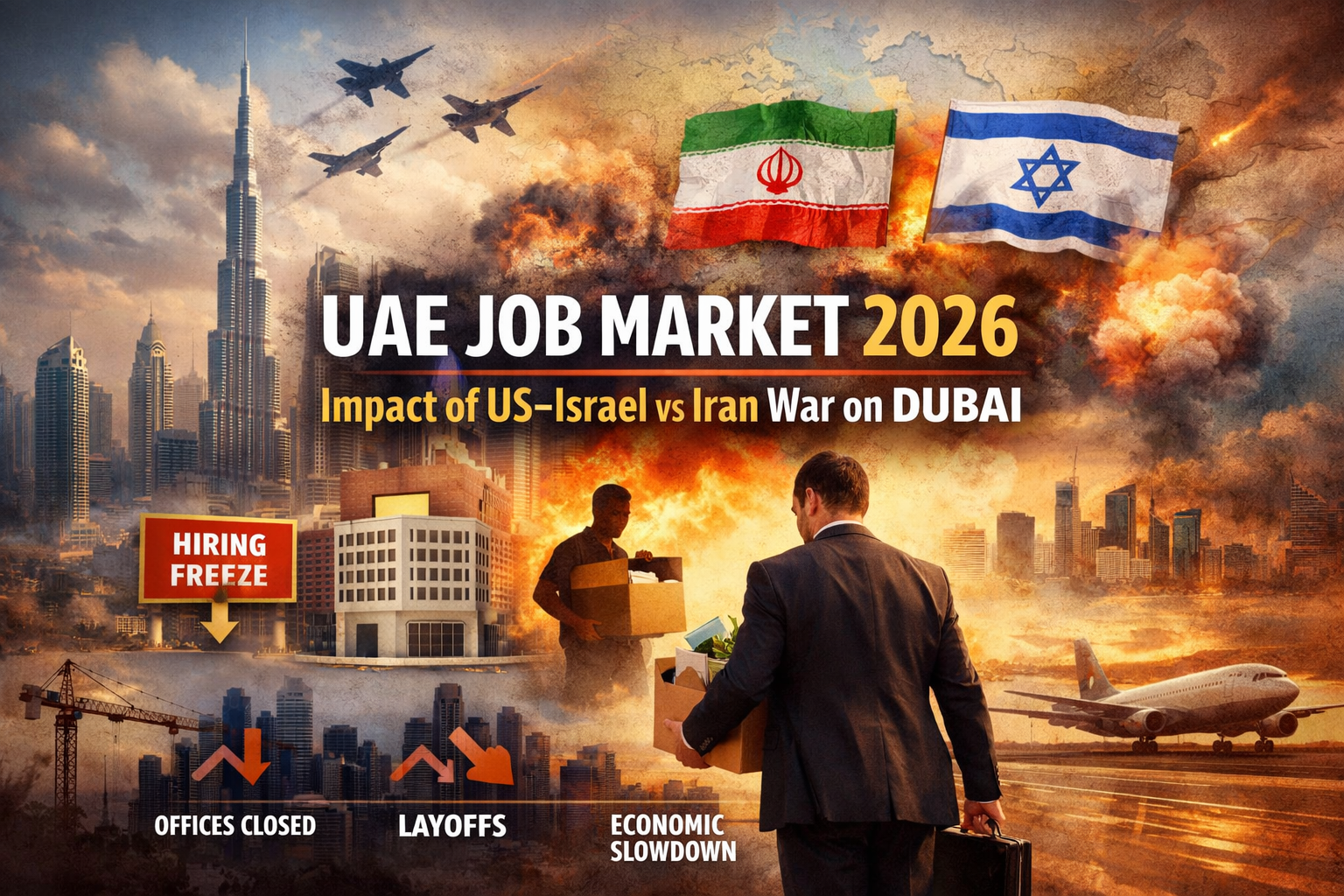
Technology, finance, consulting, and real estate sectors have all reported a decline in new job postings. Many companies have adopted a cautious approach, pausing expansion plans and freezing hiring for non-essential roles. Recruiters in the region have described the situation as unusually quiet, with fewer job openings and reduced employer activity.
This slowdown is largely driven by uncertainty. Businesses are hesitant to commit to long-term investments or workforce expansion while geopolitical risks remain high. As a result, job seekers—especially expatriates—are finding it increasingly difficult to secure employment in Dubai.
Shift Toward Remote Work and Temporary Office Closures
Another major development has been the shift toward remote work. Several multinational corporations operating in Dubai have implemented contingency measures to ensure employee safety and business continuity.
In some cases, offices—particularly in financial districts—have been temporarily closed or partially vacated. Employees have been instructed to work from home or relocate temporarily to safer regions. These decisions are not necessarily signs of economic collapse but rather precautionary steps in response to security concerns.
This shift has reinforced the growing acceptance of remote work in the UAE. While Dubai has traditionally emphasized in-office work culture, the current situation has accelerated the adoption of flexible work arrangements.
Layoffs: Reality vs Rumors
Despite widespread concern on social media, there is no verified evidence of mass layoffs across Dubai’s job market as of March 2026. However, this does not mean workers are unaffected.
Instead of large-scale layoffs, companies are implementing more subtle cost-control measures. These include hiring freezes, delays in onboarding new employees, and non-renewal of short-term contracts. In some industries, project-based work has slowed down, indirectly impacting freelancers and contract workers.
Employees working in sectors heavily dependent on international activity—such as tourism, aviation, and logistics—face higher risks. Flight disruptions and reduced travel demand have created operational challenges, which could eventually translate into job losses if the situation persists.
Business Disruptions and Economic Pressure
The conflict has also disrupted key business operations across the UAE. Logistics and supply chains have been particularly affected, with increased shipping costs and delays due to regional instability.
Dubai’s economy relies heavily on its strategic position as a global trade and logistics hub. Any disruption in shipping routes, air traffic, or port operations directly impacts businesses operating in the region.
Tourism, another major pillar of Dubai’s economy, has also taken a hit. Reduced travel activity and safety concerns have led to lower hotel occupancy rates and fewer international visitors. This has a direct effect on jobs in hospitality, retail, and entertainment sectors.
Real Estate Market Shows Signs of Weakness
Dubai’s real estate sector, which has been a key driver of economic growth, is beginning to show signs of strain. Property transactions have declined, and price growth has slowed in several areas.
Investors are adopting a wait-and-see approach, delaying major purchases until the geopolitical situation stabilizes. This has impacted real estate agents, property developers, and construction companies.
While the market has not crashed, the slowdown is significant enough to affect employment opportunities within the sector. Jobs related to sales, construction, and project management are experiencing reduced demand.
Changing Workforce Dynamics
One notable trend during this period is the shift in workforce behavior. Some expatriates are choosing to leave the UAE temporarily, while others are postponing relocation plans.
Dubai’s workforce is heavily reliant on foreign talent, and any decline in expat inflow can influence the job market. Companies may find it easier to retain existing employees but harder to attract new talent.
At the same time, employees currently in Dubai are becoming more cautious. Job security has become a top priority, with many professionals avoiding risky career moves or job switches during this uncertain period.
Sectors Showing Resilience
Despite the challenges, not all sectors are struggling. Some areas of the economy continue to demonstrate resilience.
The financial sector remains relatively stable, with major institutions adapting to the situation rather than withdrawing. Investment activity, while slower, has not stopped entirely. Certain private equity and long-term investment deals are still being executed, signaling confidence in the UAE’s long-term prospects.
Additionally, industries such as information technology, cybersecurity, and digital services are maintaining steady demand. As businesses shift toward remote operations, the need for digital infrastructure and support services continues to grow.
Market Sentiment and Business Confidence
Perhaps the most significant impact of the conflict is on market sentiment. Even in the absence of widespread layoffs or economic collapse, uncertainty alone can influence business decisions.
Companies are delaying expansion plans, reducing operational risks, and focusing on maintaining stability. Investors are cautious, and consumers are spending less in certain sectors.
Dubai’s usually vibrant atmosphere has become noticeably quieter, reflecting a broader sense of caution among residents and businesses. However, it is important to note that this is a temporary reaction rather than a permanent decline.
Comparison with Past Crises
The current situation shares similarities with previous global disruptions, such as the early stages of the COVID-19 pandemic. During those times, uncertainty led to hiring freezes, remote work adoption, and reduced economic activity.
However, Dubai demonstrated strong resilience and recovered quickly once conditions stabilized. A similar pattern could emerge if geopolitical tensions ease in the coming months.
The UAE government has a track record of implementing effective economic policies and crisis management strategies. This provides a level of confidence that the economy can withstand short-term shocks.
Future Outlook
Looking ahead, the future of Dubai’s job market largely depends on how the geopolitical situation unfolds. If tensions de-escalate, hiring activity is expected to rebound, and business confidence will improve.
On the other hand, a prolonged conflict could lead to deeper economic challenges, including more significant job losses and reduced investment. Key sectors such as tourism, real estate, and logistics would be particularly vulnerable in such a scenario.
For now, the job market remains in a state of cautious stability. Opportunities still exist, but competition is higher, and employers are more selective.
Conclusion
The US–Israel vs Iran conflict has undoubtedly disrupted Dubai’s job market, but the situation is more nuanced than it may appear. While hiring has slowed, offices have shifted to remote operations, and certain sectors are under pressure, there is no evidence of a complete economic breakdown.
Dubai continues to function as a global business hub, albeit with increased caution and reduced activity. The absence of mass layoffs and the continued presence of investment activity indicate underlying economic strength.
For job seekers and professionals, the key is to remain adaptable, focus on in-demand skills, and be prepared for a competitive job environment. For businesses, the priority remains resilience and strategic planning.
Ultimately, Dubai’s ability to navigate this crisis will depend on both regional stability and its own economic adaptability. If history is any indication, the city is likely to recover—once the uncertainty fades.
Written By; Maryam Khurshid
Media Advisor
Dubai Job Market